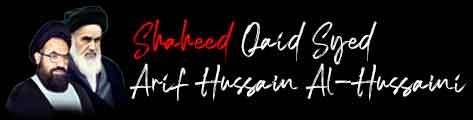
Shaheed Arif Hussain Al-Hussaini was a man of great courage and determination. He was a leader who combined deep knowledge, clear vision, and practical wisdom. Wherever he went, he inspired people with his strong faith, sincerity, and fearless character. His honesty, firm beliefs, and political awareness gave Pakistan’s Shia community a new identity. He was a beloved and respected leader, the Martyr of the Nation, Allama Syed Arif Hussain Al-Hussaini, who raised the voice of truth and justice to the highest level.
Allama Arif Hussain Al-Hussaini was born on November 25, 1946 in the village of Piewar near Parachinar, in the Kurram region. He came from a religious family known for its knowledge, piety, and honesty. After completing his early education in his hometown, his love for learning led him toward religious studies. His search for spiritual and intellectual growth took him to the Seminary of Najaf al-Ashraf, where Imam Khomeini’s scholarly and revolutionary leadership was gaining strength.
During his time in Najaf, Imam Khomeini’s teachings and example had a deep effect on him. He became not only a devoted student but also a true follower and messenger of Imam Khomeini’s ideas. He worked hard to spread those teachings through action and example. In 1975, the Ba’athist government expelled him from Iraq because of his political activities. Yet true belief cannot be limited by borders, and his heart continued to beat with loyalty to Imam Khomeini’s cause.
During the struggle against the Shah’s tyranny in Iran, he lived in the holy city of Qom, where he continued his studies while also taking part in the Islamic movement. The SAVAK, Iran’s brutal secret police, tried many times to silence him, but he never gave in. He was trained in the school of Imam Husayn (peace be upon him), who taught the lesson of “Hayhat minna al-dhilla,” meaning “We will never accept humiliation.” He stood firm against oppression until he too was forced to leave Iran.
He returned to Pakistan unwillingly, at a time when Imam Khomeini’s Islamic Revolution was at its peak. Once back home, he dedicated all his efforts to the moral, educational, and political awakening of the people. He built mosques and seminaries, supported the poor, cared for orphans and widows, and spread the message of revolutionary Islamic thought.
On 10 February 1984, after the death of Mufti Jafar Hussain, the Supreme Council of the Tehreek-e-Nifaz-e-Fiqh-e-Jafariya, the largest Shia religious and political organization in Pakistan, chose him as their new leader. From that moment, he began a movement that awakened the nation, stood up to oppression, and gave hope to the weak. His leadership became a storm against tyranny and injustice. It lit the darkness of dictatorship and spread a new spirit of unity and courage across the Muslim world. His vision brought hearts together and created a new front in the struggle against oppression, sectarianism, and foreign control.
One of the most important parts of his leadership was his deep commitment to the unity of the Muslim Ummah. With honesty and love, he worked to bring Muslims together and end sectarian conflict within Pakistan. He bravely spoke out against global arrogance, especially the United States, and called for unity based on the teachings of the Qur’an and the Sunnah.
At the historic “Qur’an and Sunnah Conference” held in Lahore on July 6, 1987, he presented a revolutionary plan that deeply moved the nation and began to heal the misunderstandings between Sunni and Shia Muslims.
His growing influence and fearless stand against oppression became intolerable to the enemies of Islam. The same global forces that had killed Ayatollah Muhammad Baqir al-Sadr and his sister Bint al-Huda, and had made Imam Musa al-Sadr disappear in Libya, now targeted him. In that same chain of tragedies came the martyrdom of Pakistan’s great leader, Allama Syed Arif Hussain Al-Hussaini.
On August 5, 1988, the enemies of faith took his life, but they could not silence his message. His thoughts and teachings remain alive and powerful to this day. Imam Khomeini, the great revolutionary leader, said with deep sorrow, “I have lost a beloved son.”
Even today, the Muslims of Pakistan continue their journey under the light of the ideas and example of Shaheed Allama Syed Arif Hussain Al-Hussaini, who will always be remembered as a symbol of faith, courage, and unity.